
“No broccoli, ah!”
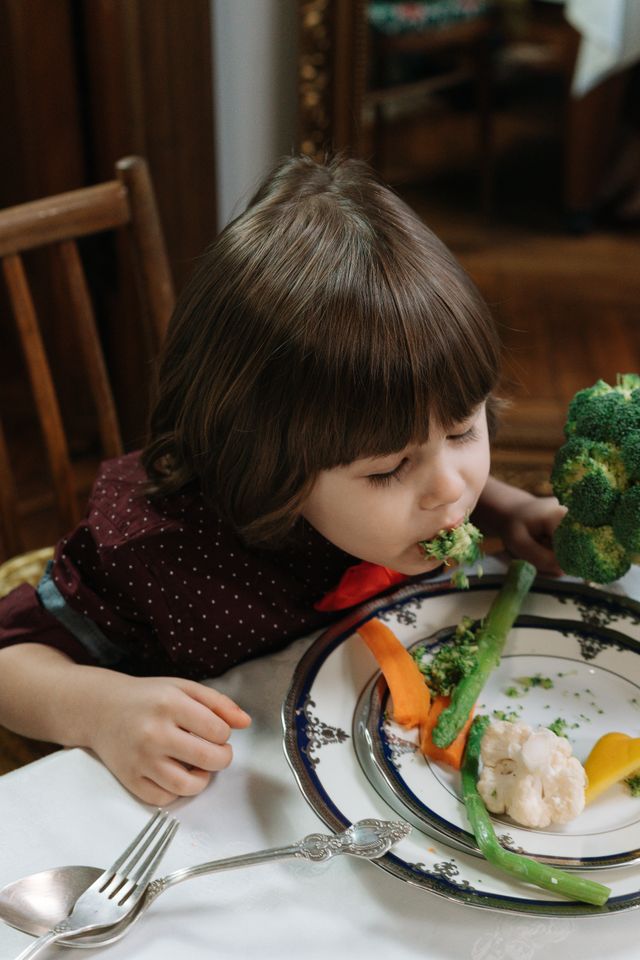
Every dinnertime, little Siti shouts that before dropping the fork and running off, leaving her parents worried and the plate half-full. Does this sound all too familiar to you? You’re not alone. Many Malaysian families struggle with picky eaters, children who seem to reject everything green except maybe cucumbers and grapes.
Picky eating isn’t just stubbornness. It is often a normal part of child development, especially between the ages of 2 and 5, when children begin to assert independence and develop food preferences (Pjetraj et al. 2025). This happens because their tastes change as they grow.
Why Do Children Become Picky Eaters?
Picky eating is not “bad parenting”. Research shows that it can be tied to a mix of sensory sensitivity, cognitive development, and early food experiences (Cunliffe et al. 2022; Taylor & Emmett 2019). Some children are more sensitive to certain textures, smells, or flavours. Foods that feel “slimy”, “lumpy” or smell unfamiliar can be overwhelming for them. Children’s early food experiences also matter. Limited exposure to different textures or flavours can make new foods feel scary later on. Parents’ stress at mealtimes can unintentionally add pressure, making children even more resistant. Research shows that higher levels of parental stress, criticism, and emotional overinvolvement are linked to more restrictive eating in children. Children exposed to these patterns tend to accept fewer foods and may have lower body weight. This suggests that a parent’s emotional response around food can unintentionally influence a child’s eating behaviour. In short, picky eating is common and often a normal phase, but it can still cause stress at mealtimes and raise concerns about nutrition and variety.
How to Handle Picky Eating Without the Battle?
1. Do Food Chaining
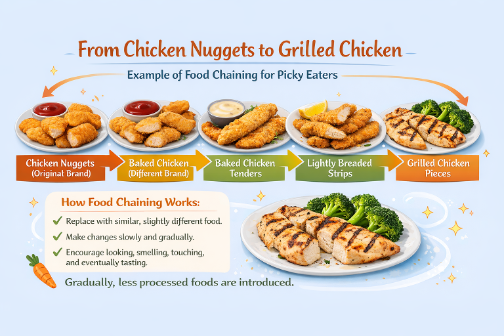
Food chaining is a gentle method that helps children accept new foods by making small, safe changes to foods they already like. Instead of forcing unfamiliar foods, parents introduce new foods that are similar in taste, texture, colour, or shape, so the child feels comfortable and confident trying them. By changing only one feature at a time, food chaining makes new foods feel predictable rather than overwhelming, helping children gradually expand their food choices without pressure or conflict.
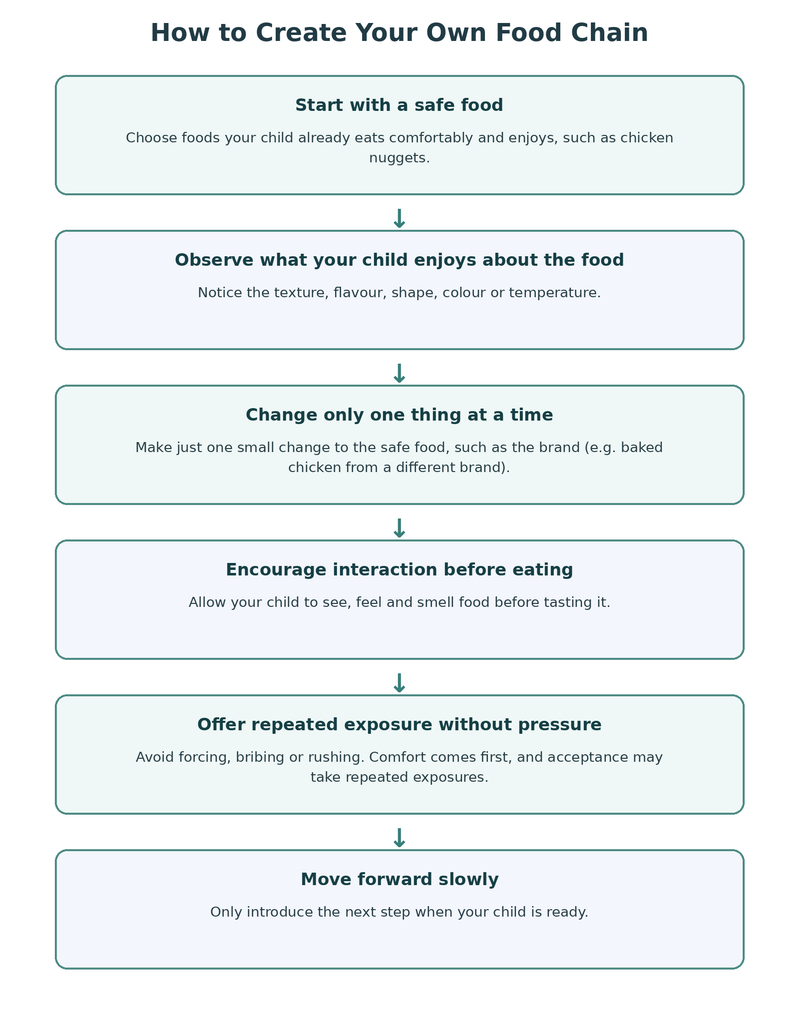
The food chaining example below shows how a child can slowly move from eating chicken nuggets, which feel safe and familiar, to grilled chicken, a food they are afraid to try. Later in this article, you will learn how to create your own food chains step by step.
How to Create Your Own Food Chains Based on the Illustration Above
Research shows that picky eaters often need to see or try a new food 10 to 15 times before they are willing to accept it. This means refusing food at the beginning is completely normal and does not mean the approach is not working. With food chaining, repeated and pressure-free exposure allows children to gradually feel more comfortable, making it an effective way to expand their food choices over time.
2. Keep Mealtimes Calm and Pressure-Free
Pressuring a child to eat rarely works and can create negative associations with food (Powell et al. 2017). Experts recommend serving new foods without demanding they be eaten, removing distractions like TV or toys, and letting the child explore at their own pace. Sit together as a family when possible; kids are more likely to sample new foods when they see others enjoying them.
3. Let Them Explore With All Their Senses
A bite test is a gentle way to introduce new foods (Moding et al. 2020). Allow children to touch, smell, and even play with food before tasting it. This kind of sensory exploration helps build comfort and curiosity. For example, start by cutting carrots or cucumbers into small pieces. When the child is ready, encourage them to touch, lick and finally take a small bite. Repeat this step several times, as familiarity grows with repeated exposure.
4. From Kitchen Helper to Happy Eater
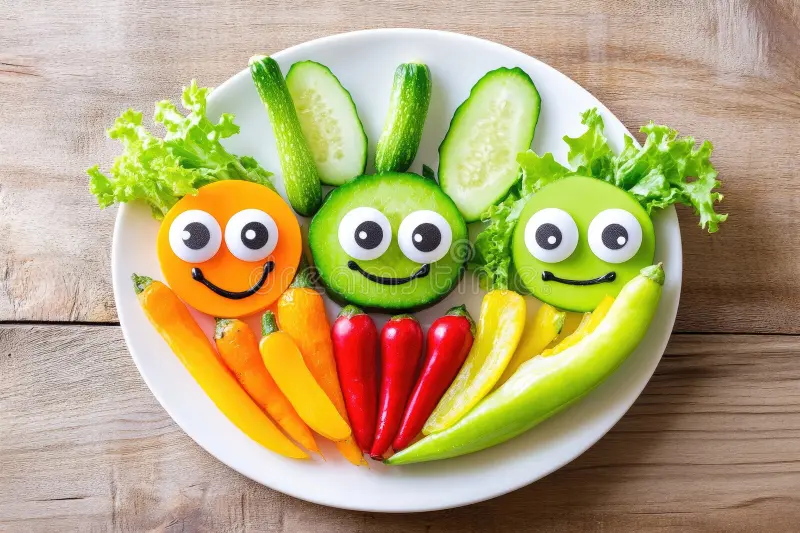
Involving children in meal planning or food preparation gives them a sense of ownership and often increases their willingness to taste new foods (Chu et al. 2013). Simple tasks like washing vegetables or stirring ingredients help them feel included. Bringing them along when grocery shopping and letting them choose a new fruit or vegetable can also empower them. Talk about food in a positive, descriptive way, such as “This carrot is crunchy!” or “This fish smells fresh!” You can even ask your child to arrange their food into a fun bento-style plate. This will help the food feel more familiar and encourage them to try it.
5. Make It Fun, Not a Chore
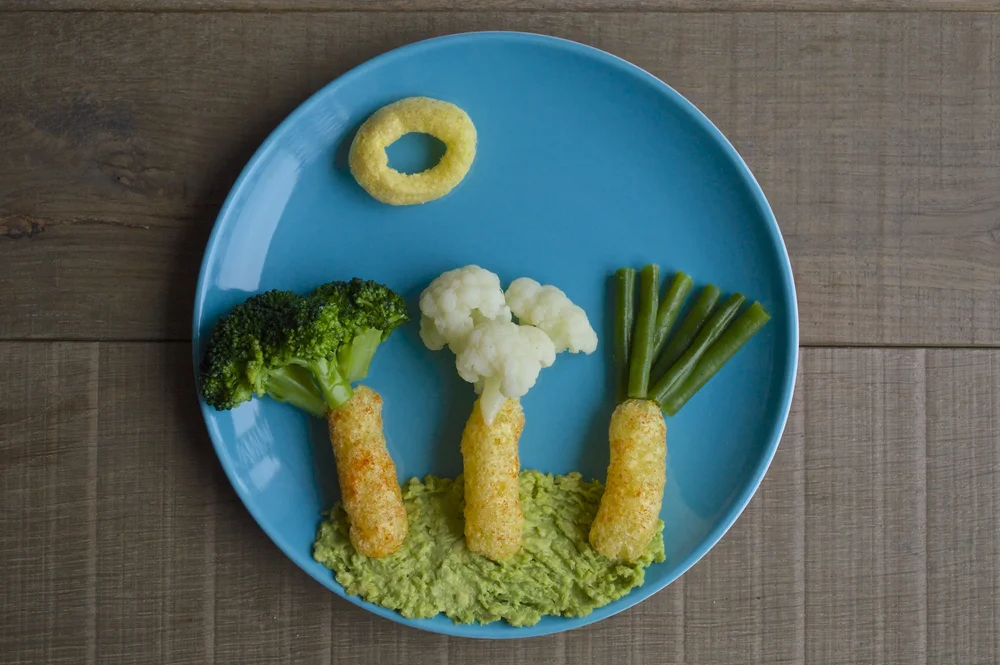
Kids love play and imagination. Renaming foods or making fun shapes can make new foods more appealing. For example, “Superhero broccoli trees”, “Rainbow rice” or “Power peas”. These strategies turn eating into a game, not a demand.
6. One Plate, Old and New
Parents can serve a new food alongside a familiar favourite on the same plate. For example, broccoli is introduced along with macaroni and cheese. The child does not need to eat the new food. Simply seeing it regularly helps build familiarity over time.
What to Avoid?
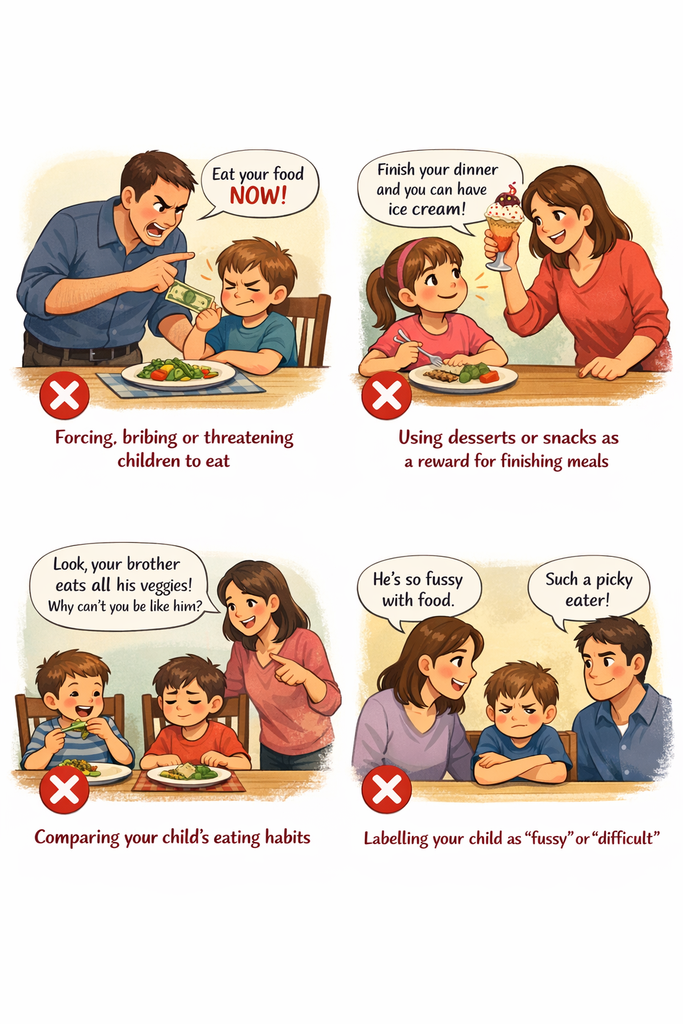
Evidence suggests that such practices may heighten children’s anxiety around food and reduce their willingness to try new foods.
When to Seek Support?
Picky eating becomes a concern if your child:
- Loses weight or fails to grow as expected
- Has extremely limited food variety (e.g. eats fewer than 10–15 different foods, repeatedly relies on the same foods and consistently refuses most new or unfamiliar foods over time)
- Avoids entire food groups
In such cases, talk with a paediatrician or dietitian to assess whether further support is needed. Nutrient shortfalls, especially in iron, zinc and fibre, can happen when variety is very limited.
Final Bite: Practice Patience, Not Pressure
The journey from “No!” to “Yum!” isn’t linear, and it shouldn’t feel like a battle. Think of food as an adventure: a series of calm, playful, and repeated invitations to discover new flavours. With patience, creativity, and positive mealtimes, many picky eaters learn to enjoy foods beyond their comfort zones.
This article is written by Nur Syaidatul Nisha Binti Shahril Effendy and Lee Sie Yin (Final Year Dietetic Students, Faculty of Health Sciences, Universiti Kebangsaan Malaysia) and was supervised by Dr. Munirah Binti Ismail (Dietetic Lecturer, Centre for Healthy Ageing and Wellness (H-CARE), Faculty of Health Sciences, Universiti Kebangsaan Malaysia) and Cik Husna Binti Hanifah Syukri (Clinical Dietitian, Hospital Tunku Ampuan Besar Tuanku Aishah Rohani, Hospital Pakar Kanak-Kanak UKM, Hospital TABTAR)
References:
- Al-Beltagi, M., Choueiry, E., Alahmadi, N., Demerdash, Z., Helmi Ayesh, W., Al-Said, K., Al-Haddad, F., Shaaban, S. Y. & Tawfik, E. 2025. Diet fortification for mild and moderate picky eating in typically developed children: Opinion review of Middle East consensus. World J Clin Pediatr 14(1): 101769.
- Birch, L. L., McPhee, L., Shoba, B. C., Pirok, E., & Steinberg, L. 1987. What kind of exposure reduces children’s food neophobia? Appetite, 9(3), 171–178.
- Chen, J.-L., Doong, J.-Y., Tu, M.-J. & Huang, S.-C. 2024. Impact of Dietary Coparenting and Parenting Strategies on Picky Eating Behaviors in Young Children. Nutrients. 16 (6): 898.
- Coulthard, H., Harris, G. & Emmett, P. 2009. Delayed introduction of lumpy foods to children during the complementary feeding period affects child’s food acceptance and feeding at 7 years of age. Matern Child Nutr 5(1): 75-85.
- Fishbein, M., Cox, S., Swenny, C., Mogren, C., Walbert, L. & Fraker, C. 2006. Food chaining: a systematic approach for the treatment of children with feeding aversion. Nutr Clin Pract 21(2): 182-184.
- Klüber, H. L., Martin, A., Schlensog-Schuster, F., Hiemisch, A., Kiess, W., Hilbert, A. & Schmidt, R. 2025. Parental psychopathology and expressed emotion in children with avoidant/restrictive food intake disorder. Child Adolesc Psychiatry Ment Health 19(1): 66.
- Mascola, A. J., Bryson, S. W. & Agras, W. S. 2010. Picky eating during childhood: a longitudinal study to age 11 years. Eat Behav 11(4): 253-257
- World Health Organization (WHO). (2023). Responsive Feeding: Guiding Principles for Caregivers.
- Pjetraj, D., Pjetraj, A., Sayed, D., Severini, M., Falcioni, L., Svarca, L. E., Gatti, S. & Lionetti, M. E. 2025. Decoding Picky Eating in Children: A Temporary Phase or a Hidden Health Concern? Nutrients. 17 (24): 3884.
- Taylor, C. M. & Emmett, P. M. 2019. Picky eating in children: causes and consequences. Proc Nutr Soc 78(2): 161-169.
- Cunliffe, L., Coulthard, H. & Williamson, I. R. 2022. The lived experience of parenting a child with sensory sensitivity and picky eating. Matern Child Nutr 18(3): e13330.
- Chu, Y. L., Farmer, A., Fung, C., Kuhle, S., Storey, K. E. & Veugelers, P. J. 2013. Involvement in home meal preparation is associated with food preference and self-efficacy among Canadian children. Public Health Nutr 16(1): 108-112.
- Moding, K. J., Bellows, L. L., Grimm, K. J. & Johnson, S. L. 2020. A longitudinal examination of the role of sensory exploratory behaviors in young children’s acceptance of new foods. Physiol Behav 218(112821.
- Powell, F., Farrow, C., Meyer, C. & Haycraft, E. 2017. The importance of mealtime structure for reducing child food fussiness. Matern Child Nutr 13(2):