
Human Herpesvirus 6 (HHV-6) is one of the most ubiquitous viruses in children, with seroprevalence reaching nearly 100% by the age of three years. While widely known as the aetiological agent of Roseola Infantum, the clinical spectrum of HHV-6 extends far beyond a benign childhood rash, frequently driving emergency department visits for acute febrile illnesses and seizures. This article aims to provide an update on HHV-6 infections in children, as despite its relative commonness, HHV-6 remains an unfamiliar pathogen among healthcare professionals, likely exacerbated by the lack of available clinical testing.

Virologic Profile
HHV-6B is a member of the Herpesviridae family. HHV-6 replicates in activated CD4+ T lymphocytes. Like other herpesviruses, HHV-6B establishes latency after primary infection and can be reactivated in an immunocompromised state. Transmission of the virus is largely through the saliva of an infected host. Historically classified as a single virus, HHV-6 is now recognized as two distinct species with different epidemiologic and clinical profiles. Understanding this distinction is crucial for accurate clinical assessment and prognostication.
| Variant | Epidemiology & Tropism | Clinical Significance |
| HHV-6B | Acquired in infancy (peak 6–18 months). Highly neurotropic. | The primary cause of roseola infantum. Responsible for >95% of primary paediatric HHV-6 infections and associated febrile seizures. |
| HHV-6A | Acquired later in life; geographic variation (more common in parts of Africa). | Rarely causes roseola. More frequently implicated in adult neuroinflammatory conditions and distinct latent infections. |
Clinical Features
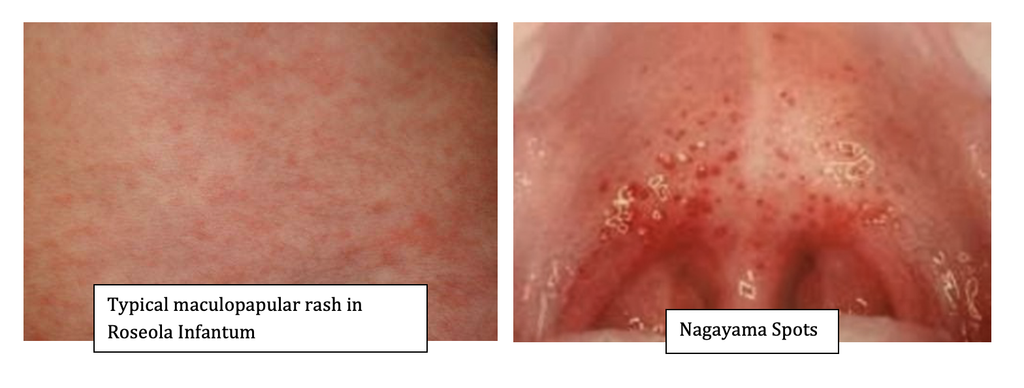
The hallmark presentation of primary HHV-6B infection is an abrupt onset of high fever (often >40°C) lasting 3 to 5 days, accompanied by a runny nose and irritability, followed by rapid defervescence and the simultaneous appearance of a blanching, maculopapular rash on the trunk that spreads to the extremities. However, this ‘classic’ presentation occurs in only about 20–30% of cases.
Key clinical manifestations to monitor include:
- Acute Undifferentiated Fever: Up to 80% of primary infections present without the classic rash, making HHV-6 a leading cause of acute, unexplained fever in infants.
- Nagayama Spots: Erythematous papules found on the soft palate and uvula, often visible during the febrile phase before the cutaneous rash appears.
- Tympanic Membrane Inflammation: Often misdiagnosed as acute otitis media due to bulging and erythema of the tympanic membrane, leading to unnecessary antibiotic prescriptions.
- Cervical Lymphadenopathy: Pronounced postauricular and occipital node enlargement is common.
Complications
While primary infection is generally self-limiting, the virus’s strong neurotropism frequently leads to central nervous system (CNS) involvement.
- Febrile Seizures: HHV-6 is the most common viral trigger for complex and prolonged febrile seizures in infants, accounting for up to 15% of all paediatric febrile seizures. These can occur even during the pre-eruptive febrile phase.
- Encephalitis and Meningoencephalitis: Though rare in immunocompetent hosts, HHV-6 can cause severe viral encephalitis. Suspect this in children presenting with prolonged altered mental status, focal neurological deficits, or status epilepticus.
- Myocarditis and Hepatitis: Extraneural complications are rare but documented, presenting as acute liver failure or unexplained cardiac dysfunction in otherwise healthy toddlers.
- Immunocompromised Hosts: In paediatric oncology or post-haematopoietic stem cell transplant (HSCT) patients, HHV-6 reactivation can be devastating, leading to limbic encephalitis, bone marrow suppression, and pneumonitis.
Investigations
- Diagnosis of HHV-6 infection is largely clinical based on the presence of a constellation of symptoms and the absence of other plausible pathogens. In severe cases or immunocompromised children, microbiological evidence of active HHV-6 replication is recommended through either quantitative or qualitative polymerase chain reaction (PCR) tests on serum or CSF samples. HHV-6 serological testing generally has limited sensitivity and specificity due to cross-reactions with other herpesviruses.
Treatment
For the vast majority of immunocompetent paediatric patients, management is entirely supportive.
- Antipyretic Therapy: Paracetamol or ibuprofen to manage discomfort and control fever.
- Hydration: Maintenance of oral intake to prevent dehydration during the high-fever phase.
- Parental Anticipatory Guidance: Reassuring parents about the benign nature of the rash (which requires no topical treatment and fades in 1–3 days) and the self-limiting course of the fever is the most critical intervention.
- Antiviral Therapy: Routine antiviral therapy is contraindicated for typical roseola. However, for severe manifestations including encephalitis or in immunocompromised patients with documented invasive reactivation, antiviral therapy is warranted. Ganciclovir and Foscarnet are the primary agents of choice, often used alone or in combination depending on the severity of viral replication and end-organ damage. Cidofovir serves as a second-line option. The choice of an appropriate antiviral should be discussed with a paediatric infectious diseases consultant.
Prognosis
The long-term outlook for immunocompetent children following a primary HHV-6 infection is generally favourable. The virus establishes lifelong latency in monocytes and macrophages, but reactivation in a healthy host is clinically silent. Immunity is considered lifelong, and secondary episodes of roseola are exceedingly rare. Even in cases of HHV-6-induced febrile seizures, longitudinal studies show no increased risk of subsequent epilepsy or neurodevelopmental delays compared to the general population, provided the neurological exam normalizes following the course of the acute illness.
References
- Chua KB, Lam SK, Sazaly AB, Lim ST, Paranjothy M. Uvulopalatoglossal junctional ulcers–an early clinical sign of exanthem subitum due to human herpesvirus 6. Med J Malaysia. 1999;54:32-6.
- Kimberlin DW, Banerjee R, Barnett ED, Lynfield R, Sawyer MH (Eds), American Academy of Pediatrics. Human herpesvirus 6 (including roseola) and 7. In: Red Book: 2024-2027 Report of the Committee on Infectious Diseases, 33rd ed
- Hall CB, Long CE, Schnabel KC, et al. Human herpesvirus-6 infection in children. A prospective study of complications and reactivation. N Engl J Med 1994; 331:432.
- Ward KN, Andrews NJ, Verity CM, et al. Human herpesviruses-6 and -7 each cause significant neurologicalal morbidity in Britain and Ireland. Arch Dis Child 2005; 90:619.
- Dermnetnz.org