
Imagine you are standing at the edge of a pool, watching children splash around. One of them is yours and has just been diagnosed with epilepsy. You want your child to enjoy the moment too. But the worry is there. Is it safe? What if your child has a seizure in the water? What should you do?
Many families of children with epilepsy face the same dilemma. There is a constant tension between wanting to give your loved one a normal, fulfilling life and the quiet fear that resurfaces whenever water is involved. This article is here to help you understand what the evidence says and how to make informed, confident decisions.
WHAT DOES THE EVIDENCE SAY?
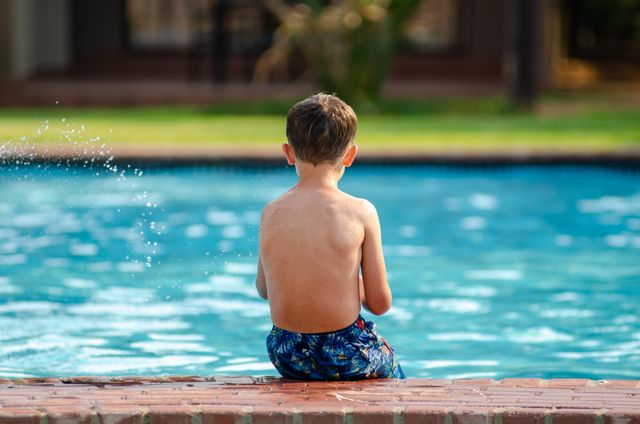
Let us be honest. People with epilepsy face a significantly higher risk of drowning than the general population. Some studies report up to a tenfold higher risk (Bain et al., 2018). This risk is greatest during unsupervised water activities or when seizures are poorly controlled. Most epilepsy-related drowning deaths occur in bathtubs and during solo swimming, where no one is present to respond quickly. Even shallow water can pose a real danger during a seizure.
For many years, people with epilepsy were routinely advised to avoid physical activity altogether, including swimming, largely because of concerns that exercise might trigger seizures or lead to injury. In 1968, the American Medical Association formally recommended restricting sports participation for people with epilepsy.
Many parents worry that “overdoing it” in the pool will trigger a seizure. However, research suggests that the opposite is usually true. Interestingly, exercise-induced hyperventilation differs from the hyperventilation used during an electroencephalogram (EEG) to provoke seizures. During exercise, the body produces compensatory physiological responses that may actually suppress abnormal brain activity. In fact, numerous studies have shown that regular aerobic exercise can reduce seizure frequency while improving mental health and overall well-being.
To help families make informed decisions, the International League Against Epilepsy (ILAE) classifies sports into three groups. Swimming is considered a Group 2 sport. This means it carries a moderate risk for the person with epilepsy but, unlike Group 3 sports such as scuba diving or rock climbing, it does not typically pose a risk to bystanders or the public. Because the risk is specific to the swimmer, it can usually be managed with appropriate supervision.
THE “ONE-YEAR RULE” — AND WHY IT IS NOT SET IN STONE
You may have heard that a child should be seizure-free for at least one year before swimming. This recommendation is widely practised, but it is important to understand that it is based primarily on expert opinion rather than strong clinical evidence. There are no large-scale studies confirming exactly how long a seizure-free period makes swimming safe.
Every child is different. Factors such as seizure type, seizure frequency, seizure triggers, cognitive ability, and response to medication all influence the level of risk. A child who has been seizure-free and responds well to treatment may have a lower risk than one whose seizures remain unpredictable.
The bottom line is simple: always consult your child’s neurologist or paediatrician. They are best placed to assess these individual factors and advise whether swimming is appropriate for your child. In Malaysia, the Malaysian Epilepsy Society (MES) also provides guidance and support for families navigating these decisions.
PRACTICAL SAFETY TIPS FOR PARENTS
If your child’s doctor gives the green light for swimming, here are some practical ways to make it as safe as possible. These recommendations apply whether your child swims at a community pool, a school programme, or a private facility.
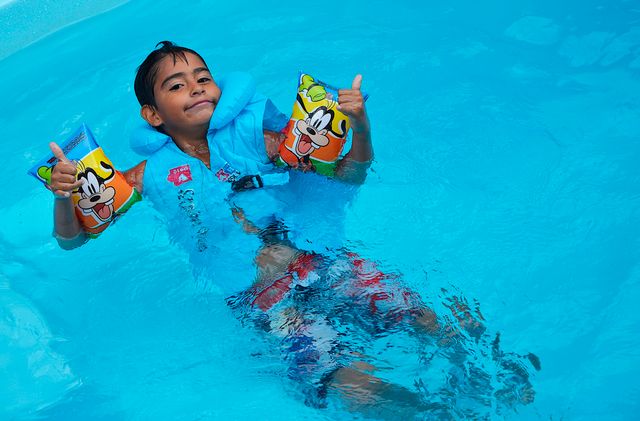
Never swim alone. Your child should always remain within arm’s reach of a responsible adult who knows about the epilepsy diagnosis and understands what to do if a seizure occurs. This is not the time to be scrolling through your phone at the poolside.
Choose the right setting. Supervised swimming pools with trained lifeguards are much safer than open water, rivers, lakes, or the sea. At home, showers are considerably safer than unsupervised baths.
Have a seizure action plan. Anyone supervising your child should know how to recognise a seizure, safely support your child in the water, when to call for emergency medical assistance, and ideally, how to perform cardiopulmonary resuscitation (CPR).
Inform the swimming instructor. Swimming instructors, coaches, and school staff should be informed about your child’s epilepsy before any lesson begins.
Take medication as prescribed. Ensure your child takes antiepileptic medication exactly as prescribed. Missing doses may increase the risk of seizures.
Brighten up. Have your child wear a brightly coloured swim cap. This makes your child much easier for a lifeguard or supervisor to spot in a crowded pool.
Watch the light. If your child has photosensitive epilepsy, where flickering light can trigger seizures, sunlight reflecting off the water may also be a trigger. High-quality polarised goggles or sunglasses may help reduce these reflections.
Watch breathing patterns. Although breathing heavily during swimming is a normal response to exercise, deliberate hyperventilation (taking repeated deep, forceful breaths before swimming) should be avoided. Forced hyperventilation while at rest can alter brain chemistry and lower the seizure threshold, making seizures more likely. Similarly, prolonged breath-holding contests underwater should be avoided.
Wear a life jacket. For children who experience frequent seizures or seizures associated with impaired awareness, wearing a properly fitted life jacket, even in a swimming pool, provides an important additional layer of safety.
WHEN TO BE EXTRA CAUTIOUS
There are situations where the “green light” for swimming may temporarily turn yellow.
Recent medication changes. If your child is starting, tapering, or changing antiseizure medication, the risk of a breakthrough seizure may be temporarily higher. It is sensible to avoid swimming during the first few months after a medication change or while medication is being withdrawn.
The “4-Year Rule” for diving. Recreational scuba diving is very different from swimming. Most experts recommend at least four to five years of complete seizure freedom—and often being off medication entirely—before considering this high-risk activity.
FINAL MESSAGE
Epilepsy should not put a full stop to childhood. With good seizure control, appropriate supervision, and a clear safety plan, most children with epilepsy can safely enjoy swimming alongside their peers.
Written by Dr Muhammad Harith Rosdi (Sports Medicine Specialist) & Dr Muhd Alwi Muhd Helmi (Paediatrician) | Clinical Lecturers, Kulliyyah of Medicine, International Islamic University Malaysia (IIUM)