
Source: www.nst.com.my
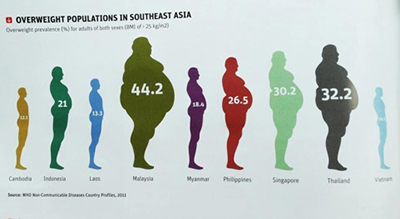
Malaysia is now officially the fattest country in South East Asia. Our overweight prevalence is around 44.2 % in 2011. Many of my patients told me that they have lost their hope and have given up on their fight against obesity. Some of them have spent thousands of ringgit on products and food supplements thought to help them to reduce weight but eventually failed. Some did achieve positive results, but only for a while and gained back weight after some time, mostly after spending all their hard earned cash on some weight loss products. Well, we can’t blame them. There are many commercial products or methods to lose weight readily available in Malaysia and there are not much control on these products or services by health authorities because of legislative limitations.
Most people will go for the fastest and easiest way available in trying to lose weight with the least effort involved even though it may cost them a lot of money. These methods, though may help some to lose weight rapidly is not sustainable in long run and does not work with majority of people, not to mention its serious side effects to human health. In most cases, the weight loss achieved is just temporary. Most who took this diet products will start gaining weight the moment they stopped the product or the treatment. It is the supplement industries’ evil and unethical marketing strategies which have conned most people into buying these products or weight losing treatments, not the true scientifically backed evidences of such products .
Why it is easier to gain weight back if you lose your weight rapidly using all these readily available diet products? I will try and explain this in the simplest way possible. Our body has a memory and a sensor for out fat storage. Because of this memory, the body will convert other readily available nutrients in our body i.e glucose and protein into fat storage when the body senses rapid fat loss in order to meet back the fat level based on existing body memory.
An example would be, if your fat % for all these years is around 33.2 %, your body will make sure that they store more fat and convert other nutrients into fat to maintain the 33.2 % of body fat in the event of rapid weight loss. This is also the reason why some obese patients undergoing Liposuction procedures need to perform this expensive procedures repeatedly and frequently simply to maintain their weight . Another example would be , obese patients who had few kilograms of their fat removed during surgical operations will simply gain back weight postoperatively. If you take a product which facilitates rapid weight loss, you will only lose weight while taking the product (during the short period of time )and the moment you stop taking it or go back to your normal diet, your body will start storing the fat back to its usual level prior to taking the product.
So, you can’t be spending a lot of money per month to continue taking this product forever isn’t it? It will not be a sustainable and economical solution to lose weight this way. Not to mention the severe life threatening side effects of rapid weight loss involving some products which resulted in Liver Failure and eventually death. So, how to ensure a sustainable and safe weight loss ?
Source: www.cool-health.com
Losing weight steadily over a longer period of time is more sustainable than losing weight rapidly. The body’s memory on our fat storage will not change in a rapid weight loss but will change in a sustainable and steady weight loss. Basically, what we are doing here is to modify the memory of our body with regards to our fat storage level steadily to prevent re-storing of fat after a steady weight loss. An example of steady but sustainable weight loss would be to lose about 12 kg over a 6 month period at a rate of 2 kg per month. So, how can we achieve this sustainable and steady weight loss?
The answer to this is to stop spending unnecessary amount of money on expensive products, treatment or equipments etc… and go back to the basics, the way our ancestors did it, through healthy diet and structured physical activity regime. In losing weight, 80 % of the effort involves healthy diet while only about 20% is due to physical activity and workouts. This is also the reason why many people exercise for hours every day but still not losing any weight because the healthy diet component is being neglected. You can work yourself out until you break your back but you will never achieve your target weight loss unless you start eating healthy. But dieting alone without the physical activity alone is also not healthy and will not work in most cases. I will elaborate further on this when I explain more on the dietary tips in my next section. Remember, Fit is not a goal, but it is a way of life.
So how can you lose weight? I will cover the following steps and tips in trying to lose weight / trim your belly fat in my next article using a Q & A approach:
- How to detox your body to improve overall body health, energy and help optimize basal metabolic rate.
- How to apply the principle of healthy diet aiming at maximizing fat burn while maintaining sufficient nutritional requirements of the body. In this section, I will explain why the use of the Malaysian Food Pyramid in the promotion of healthy eating for obese patients is entirely useless and misleading and will most probably not help you to lose weight. I will also explain why certain food items marketed by the multi-billion food industries as healthy foods are not the right foods to be taken when trying to lose some weight.
- How to exercise when trying to lose weight? A common advice from all the doctors are to exercise 20 to 30 minutes for at least 3 times a week and that is all. I will explain why this general guideline is only sufficient for general health but not enough to help you lose weight . I will explain on how can you perform a simple 15 minutes daily workout at home and achieve far greater results. I will also explain on the principles of High Intensity Interval Training ( HIIT ) and other governing principles for weight loss exercises. Most people will simply jog or buy expensive exercise equipments but do not exercise correctly using the right principles. While any type of exercise in general is good for your health and fitness level, it may not be the best if you are trying to lose weight. In general, I will cover on Structured Physical Exercise aiming at achieving weight loss through specific exercise regime with the following objectives:
-
- Increasing Basal Metabolic Rate (BMR) and Fat Loss.
- Body Toning to improve overall body muscle mass and increase BMR.
- Improving Endurance and overall fitness .
- Employment of age specific/ physical condition specific exercises. This is due to the fact that many conditions such as old age, knee and back injury etc. may require different and specific exercise regimes designed specifically for these conditions.
This is part 1 of this 4 part series on Losing weight. Stay tuned for the continuation.
Lt Col (Dr) Mohd Arshil was previously the Director for Preventive Medicine and Medical Ops , Military Health Division and is currently pursuing his DrPH. Find out more about him at The Team page.
[This article belongs to The Malaysian Medical Gazette. Any republication (online or offline) without written permission from The Malaysian Medical Gazette is prohibited.]
References:
- Claessens M et al. Glucagon and Insulin responses after ingestion of different amounts of intact and hydrolised proteins. Br J Nutr. 2008 Jul; 100(1):61-9
- Andrew R. All About Dietary Acids and Bases . http: www.precisionnutrition.com/all-about-dietary-acids-and-bases. Accessed 20 Jan 2014.
- WHO Report On Global and regional burden of disease and risk factors, (2011).
- Report of the Dietary Guidelines Advisory Committee, 2010 Dietary Guidelines for Americans. Evidence based guidelines: http:// www.cnpp.usda.gov/DGAs2010- DGACReport.htm.Accessed Jan 16, 2013
- Suitor CW, Kraak VI. Adequacy of Evidence for Physical Activity Guidelines Development: Workshop Summary. Institute Of Medicine. Washington,DC:National Academic Press; 2007.
24 comments for “Trying To Lose Weight? Are You Doing It Right? (Part 1) – Lt Col (Dr) Mohd Arshil Moideen”